

Written by the HealthWealthCare Content Team | Reviewed by Hritik Banga, Healthcare Content Expert | Last updated: November 2026
Quick Answer:
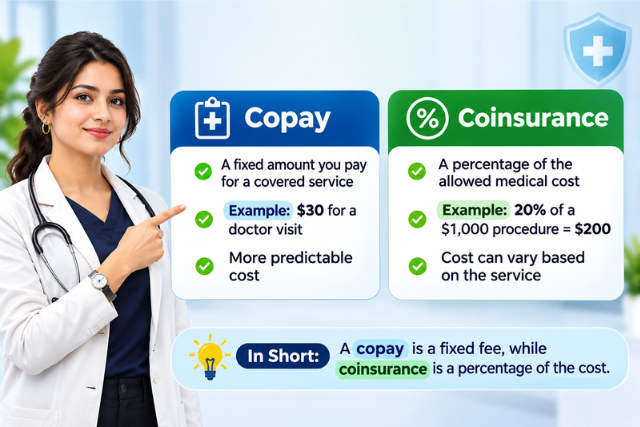
Copay vs. Coinsurance refers to two different ways you share healthcare costs with your health insurance company. A copay is a fixed amount you pay for a covered medical service, while coinsurance is a percentage of the allowed medical cost. For example, you may pay a $30 copay for a doctor visit or 20% coinsurance for a medical procedure. The amount you pay depends on your insurance plan, deductible, and coverage terms.
Ever sat on the couch with health insurance paperwork in hand and said, “Copay vs. coinsurance, which the heck is it?” Well, you’re in good company. People get confused by these two payment models, and they even act like everyone knows exactly what they are talking about but the concepts work differently in each case.
Here’s the fundamental difference of a copay vs coinsurance: A copay is a fixed dollar amount and coinsurance is a percent value.
In both cases, they share the cost when there’s a claim but the math differs significantly. I’ll explain them in detail for you, discuss when they apply to benefits, and where these differing amounts will affect your bank account.
Copay vs. Coinsurance: The Quick Comparison
| Feature | Copay | Coinsurance |
| What you pay | Fixed dollar amount | Percentage of allowed cost |
| Example | $30 | 20% |
| Predictable? | Yes, always the same | No, varies by bill size |
| Common for | Doctor visits, prescriptions | Hospital care, procedures |
| Deductible relationship | Plan-specific | Usually after deductible |
The real key: copays are predictable. Coinsurance? Not so much.
What Is a Copay? The Fixed Amount
A copay, short for copayment, is straightforward. You go to the doctor, pay a set amount out of your pocket, and that’s it. To understand this payment structure better, learn what a copay in health insurance means and when it applies.
Here’s how it works in real life:
You schedule a primary care doctor visit. The appointment happens. When you check out, the front desk tells you: “That’s a $30 copay.” You pay $30. You leave. Insurance handles the rest of the bill.
In the copay vs. coinsurance comparison, the biggest advantage of a copay is simplicity. You know exactly what you’re paying before you walk in. No surprises. Whether the doctor’s visit costs the insurance company $150 or $500, your copay stays $30. That’s the whole point.
Real example:
- Doctor visit allowed cost: $200
- Your copay: $30
- You pay: $30
- Insurance pays: $170
But here’s the catch: whether that copay applies before or after your deductible depends entirely on your specific plan. Some plans waive copays until you meet your deductible. Others don’t. You actually have to check your plan documents—boring, I know, but necessary.
What Is Coinsurance? The Percentage
Coinsurance is the flip side. Instead of a fixed amount, you pay a percentage, and the insurance company pays the rest. You can learn more about how coinsurance works in health insurance and how it affects your medical expenses.
How it works:
You have a procedure that costs $1,000 (what the insurance company allows as reasonable). Your plan says “20% coinsurance.” Do the math: you pay $200. Insurance pays $800.
But that $1,000 is the allowed amount—not what the hospital actually bills. This matters. If the hospital bills $2,000 but the allowed amount is $1,000, you don’t pay 20% of $2,000. You pay 20% of the allowed $1,000. That’s $200, not $400.
Real example:
- Hospital procedure allowed cost: $3,000
- Your coinsurance: 20%
- You pay: $600
- Insurance pays: $2,400
One major difference in copay vs. coinsurance is predictability. Coinsurance costs can vary because they depend on the allowed amount of each medical service. You don’t know ahead of time how much you’ll pay because you don’t know the allowed cost. A routine lab test might cost you $20 in coinsurance. An imaging scan might cost you $300.
The Deductible Changes Everything
Here’s where most people get confused: the deductible affects when you actually have to pay. Understanding how a health insurance deductible works can help you understand when copayments and coinsurance apply to your medical expenses.
For copays: Some plans let you pay your copay before meeting your deductible. Other plans make you meet the deductible first, then start charging copays. It depends entirely on your plan.
For coinsurance: Generally, coinsurance kicks in after you meet your deductible. So if your deductible is $1,500 and you’ve only spent $800 on healthcare, you might still owe the full allowed amount for that specialist visit (not coinsurance) until you hit $1,500.
This is why you absolutely must check your Summary of Benefits and Coverage (SBC)—your official plan document. It’s the only place that shows your specific deductible rules and when copays or coinsurance apply.
Can You Have Both a Copay AND Coinsurance?
Yes. Absolutely yes.
Your plan might work like this:
- Primary care visit: $30 copay (no deductible applies)
- Specialist visit: 20% coinsurance (after deductible)
- Emergency room: $250 copay + 20% coinsurance
- Prescription: $15 copay
As you can see, copay vs. coinsurance isn’t always an either-or choice. The same health insurance plan can use both payment methods for different medical services. That’s not a mistake in the plan design—that’s intentional. Your job is to figure out which services have which costs.
Copay vs. Coinsurance vs. Deductible vs. Out-of-Pocket Maximum
To understand copay vs. coinsurance, you also need to understand how premiums, deductibles, and out-of-pocket maximums work together.
Premium: The monthly cost you pay just to have the insurance. This happens whether you use healthcare or not.
Deductible: The amount you pay out of pocket for covered services before your insurance kicks in. If your deductible is $1,500, you pay the full allowed cost for services until you’ve spent $1,500. Then insurance starts sharing the cost.
Copay: A fixed amount you pay for a specific service (sometimes before meeting your deductible, sometimes after—it depends on your plan).
Coinsurance: A percentage of the allowed cost you pay after your deductible is met.
Out-of-Pocket Maximum: The most you’ll spend on copays, coinsurance, and deductibles in a year. This is also known as your annual out-of-pocket maximum, which limits your spending on covered healthcare services. Once you hit this number, insurance covers 100% of approved in-network services for the rest of the year. Your premiums don’t count toward this maximum.
Think of it like this: the out-of-pocket maximum is your financial safety net. It says, “No matter what happens health-wise, you won’t pay more than this amount in a year.”
Which Is Better: Copay or Coinsurance?
When deciding between copay vs. coinsurance, there isn’t one option that works best for everyone. The right choice depends on your health needs and how frequently you use medical services.
A copay might work better for you if:
- You have frequent routine visits (your predictable costs add up slower)
- You prefer knowing exactly what you’ll pay
- You see specialists regularly (fixed copays beat percentage coinsurance for predictable visits)
Coinsurance might work better if:
- You rarely need healthcare (you don’t hit the deductible often)
- You stay in-network (the allowed amounts are usually reasonable)
- Your plan has a low deductible and reasonable coinsurance percentage
But here’s the real truth: don’t choose a plan based only on copays or coinsurance. Compare the entire picture, including your monthly health insurance costs, deductible, copays, coinsurance, and out-of-pocket maximum. A plan with low copays but a huge deductible and high out-of-pocket maximum might actually cost you more than a plan with higher copays but lower overall costs.
Real-World Cost Example
Let’s say you need a specialist visit and an imaging scan. Here’s how copay and coinsurance play out differently:
Scenario 1: Copay-Based Plan
- Specialist visit copay: $50
- Imaging scan copay: $50
- Total you pay: $100
Scenario 2: Coinsurance-Based Plan (20% after $1,500 deductible)
- Specialist visit allowed cost: $300 (you’ve spent $500 of your deductible, so $300 goes toward it)
- Imaging scan allowed cost: $800 (you’ve now spent $800 of your deductible, need $200 more)
- Second imaging scan: $1,000 allowed cost (you hit the deductible, now you pay 20% = $200)
- Total you pay: $300 + $800 + $200 = $1,300
Same services. Completely different out-of-pocket costs.
How to Find Your Copay and Coinsurance Amounts
Don’t guess. Here’s exactly where to look:
- Your insurance member portal: Most insurers have online accounts where you can see your plan details. You should also understand your plan type, such as a PPO health insurance plan, to learn how its provider network and coverage arrangements work.
- Your Summary of Benefits and Coverage (SBC): This is the official document describing your plan. Get it from your insurer’s website or call and request it.
- Your plan documents: The full plan document (called the “evidence of coverage” or “certificate of benefits”) has all the detailed rules.
- Call your insurer’s customer service: If the documents confuse you, call. They can tell you exactly what you’ll pay for a specific service.
Don’t rely on memory. Don’t guess. Just look it up. It takes five minutes and saves you from surprises.
Copay vs. Coinsurance for Common Healthcare Services
Here’s what typically happens with different services (though your plan might differ):
| Service | Typical Cost-Sharing |
| Primary care visit | Copay ($20–$50) |
| Specialist visit | Copay or coinsurance |
| Prescription drugs | Copay |
| Lab tests | Copay or subject to deductible |
| Imaging (X-ray, MRI) | Coinsurance after deductible |
| Hospital stay | Deductible + coinsurance |
| Emergency room | Copay + coinsurance or deductible |
| Preventive care | Often $0 (covered fully) |
Again: These are typical patterns, not guarantees. Your specific plan might work differently.
Hospital Bills and Coinsurance: Why This Matters
Hospital care is where coinsurance gets expensive fast. A hospital stay can rack up bills in the thousands. If you’re paying 20% coinsurance on a $10,000 hospital bill, you’re writing a check for $2,000.
That’s exactly why the out-of-pocket maximum exists. Once you hit it—even if you’re in the middle of treatment—your insurance covers 100% of approved, in-network care for the rest of the year.
This is also why preventive care (like annual checkups and screenings) is often free under your plan. The insurance company saves money by catching problems early, so they cover it completely.
Does Coinsurance Count Toward Your Out-of-Pocket Maximum?
Generally, yes. Your coinsurance, copays, and deductibles all count toward your annual out-of-pocket maximum—but only for covered, in-network services. Premiums don’t count. Out-of-network care that you pay in full also typically doesn’t count (you’re not using the insurance’s negotiated rates).
Once you hit your out-of-pocket maximum, stop worrying. Insurance handles the rest of the bill for that year.
Does a Copay Count Toward Your Deductible?
This is plan-specific. Some plans allow copays to count toward the deductible. Others don’t. This is exactly why you need to read your SBC or call your insurer and ask directly: “Do my doctor visits count toward my $1,500 deductible?”
It’s a fair question. Get a clear answer.
The Bottom Line
Copay and coinsurance are both ways you share healthcare costs with your insurance company. A copay is predictable—you always pay the same amount. Coinsurance is percentage-based—the amount changes depending on the bill size.
Neither is inherently “better.” The right cost-sharing structure depends on your health needs and which services you actually use. Before choosing a plan, compare the full picture: premium, deductible, copays, coinsurance amounts, and out-of-pocket maximum.
Your Summary of Benefits and Coverage document has all these numbers. Read it. Or call your insurer and ask. Five minutes of clarity now saves you from stressful surprises later.
Frequently Asked Questions (FAQs)
Is a copay cheaper than coinsurance?
Not always. It depends on the service cost and your plan structure. A $50 copay on a $300 specialist visit is cheaper than 20% coinsurance. But 20% coinsurance on a $100 lab test ($20) beats a $50 copay.
Do you pay both copay and coinsurance for the same visit?
Sometimes. An emergency room visit might have a $250 copay, then 20% coinsurance on top. Check your plan details.
What does 20% coinsurance actually mean?
It means you pay 20% of the allowed cost, and insurance pays 80%. If the allowed cost is $500, you pay $100.
Which is better for expensive procedures?
Coinsurance, usually—because of the out-of-pocket maximum. Once you hit it, insurance covers 100%. With copays, you might hit the out-of-pocket max faster on smaller bills, or take longer with a massive bill. It depends.
Can I predict my annual healthcare costs?
Somewhat. If you know you’ll have a specialist visit ($50 copay), a few prescriptions ($15 each), and an imaging scan (20% coinsurance on $800), you can estimate. But unexpected health issues change the math.
Disclaimer
The information provided in this article is for general educational purposes only and should not be considered financial, medical, or insurance advice. Copayments, coinsurance, deductibles, and other cost-sharing requirements vary by health insurance plan, insurer, and coverage terms. Always review your Summary of Benefits and Coverage (SBC) and official policy documents or contact your insurance provider to confirm your specific benefits and out-of-pocket costs.