

Written by the HealthWealthCare Content Team | Reviewed by Hritik Banga, Healthcare Content Expert | Last updated: November 2026
Quick Answer
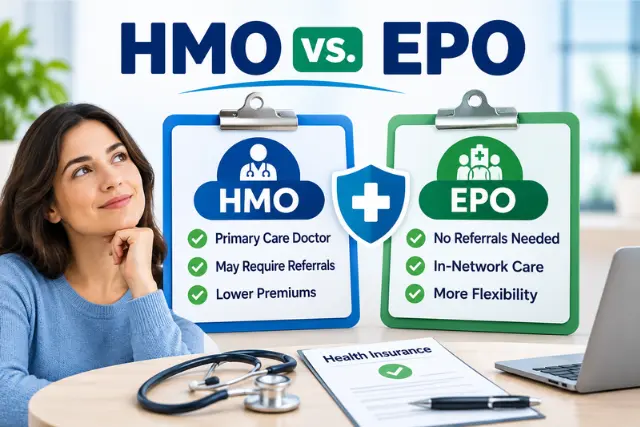
The main difference between an HMO vs. EPO health insurance plan is how you access specialist care. An HMO generally requires you to choose a primary care physician (PCP) and may require referrals to see specialists. An EPO usually allows direct specialist visits without referrals, but both plans generally require you to use in-network doctors and hospitals, except in emergencies. HMOs often have lower premiums, while EPOs offer more flexibility within their provider networks. The right choice depends on your healthcare needs, preferred doctors, and overall plan costs.
Here is the truth of health plan comparison; the majority of writeups make it seem more confusing than necessary. I will sort through that.
The difference between an HMO vs. EPO plan generally boils down to accessing your benefits. You can explore the different types of health insurance plans to understand how provider networks and referral requirements affect coverage. Your HMO and EPO benefits plan may both necessitate seeing network doctors and hospitals but allow you to receive covered care and services when it’s an emergency.
What differentiates them from one another? An HMO may ask for a referral from a primary doctor; an EPO generally would not ask from you for that.
That is a fact now let’s discuss your actual benefits.
HMO vs. EPO: The Core Difference Explained
| Feature | HMO | EPO |
| Full Name | Health Maintenance Organization | Exclusive Provider Organization |
| In-Network Coverage | Yes | Yes |
| Out-of-Network Coverage | Generally not covered except emergencies | Generally not covered except emergencies |
| Specialist Referral | May be required | Generally not required |
| Primary Care Doctor | Usually required | Not required |
| Provider Flexibility | Lower | Moderate to higher |
| Network Restrictions | Strong | Strong |
| Typical Cost | Often lower | Often competitive |
| Best For | Coordinated in-network care | Specialist access without referrals |
Real talk: Both plans funnel you into a network. The insurance company controls which doctors and hospitals you can see. Leave that network for non-emergency care? You pay the bill yourself. That’s the fundamental constraint you’re accepting with either plan.
What Is an HMO? The Coordinated Care Plan
An HMO—Health Maintenance Organization—operates on a coordination model. The insurance company wants your care organized through one primary care doctor who acts as your healthcare gatekeeper.
So what this looks like on the ground: You select a primary care doctor. When you want to see a specialist, first you see your PCP, he or she consults with you to see if you should see the specialist and writes you a referral. The specialist has to be willing to accept that referral. Yes, it adds a step. Yes, it can be irritating.
The trade-off? The PCP knows your entire medical history. Everything is connected. They aren’t just approving referrals – they’re managing your treatment. For patients with chronic illness, or complex health issues this can make a significant difference.
The network is usually smaller and more managed than other plan types. That often means lower premiums and lower out-of-pocket costs when you stay in-network. The insurance company benefits from controlled costs, and you benefit from lower monthly payments.
Important: Not every HMO requires referrals for every specialist visit. Some HMOs let you see certain specialists (like OB/GYN) without a referral. Always check your specific plan’s rules.
What Is an EPO? The Network-Based Plan
An EPO (Exclusive Provider Organization) takes a different approach. You have a network, and you’re expected to stay in it. That’s the trade. Read more about how an EPO health insurance plan works and its provider network restrictions. In exchange, the insurance company usually gives you more flexibility.
How it works: You don’t need to pick a primary care doctor. You don’t need referrals to see specialists. Want to see a dermatologist? Go directly. Need an orthopedist? Call them up. No referral required. No gatekeeper approval needed.
What you can’t do is leave the network. Non-emergency out-of-network care? Generally not covered. You pay 100% of that bill. The network is the entire deal with an EPO.
This in-between coverage is for those that want more choice over their care but are unwilling to risk the cost protections afforded by in-network care. You are partially “going it alone.”
Cost Comparison: It’s Not Just About Premiums
Everyone looks at the monthly premium first. That’s mistake number one.
An HMO might have a $150 monthly premium. An EPO might be $170. People choose the HMO based on that $20 difference and call it a day. Then they get a specialist bill for $2,000 and realize they didn’t do the math.
Monthly Premium: HMOs tend to run lower because the coordination model and network restrictions give insurance companies better cost control. EPOs often cost more monthly because you get more direct specialist access. But the difference varies by location, employer plan, and exact coverage levels.
Deductible: Both plans can have high or low deductibles. An HMO might have $500. An EPO might have $1,500. Neither plan type is automatically cheaper here. It depends on the specific plan. Learn what a health insurance deductible means before comparing the total costs of different plans.
Copays and Coinsurance: With an HMO, your PCP visit might be $20. A specialist referral might be $40. With an EPO, your specialist visit might be $50 without a referral. Again, it varies. Understanding how copays work in health insurance can help you estimate your healthcare expenses.
Out-of-Pocket Maximum: This is the number that matters most. It’s your financial ceiling for the year. Once you hit it, insurance covers 100% of approved in-network care. Compare this across plans. A plan with a higher premium but a lower out-of-pocket maximum might save you money if you have serious healthcare needs.
Out-of-Network Costs: Here’s where the math gets real. If you need non-emergency care outside the network with either an HMO or EPO? You’re probably paying full price. That’s not $40 out of pocket. That’s the provider’s full bill, which could be thousands.
HMO vs. EPO Pros and Cons
HMO Pros and Cons
| Pros | Cons |
| Often lower monthly premiums | Referrals can delay specialist access |
| Coordinated care through your PCP | Less direct specialist access |
| Primary doctor knows your medical history | Limited out-of-network coverage |
| Straightforward in-network care | Network restrictions are tighter |
| Good for people who prefer one healthcare base | Feels more restrictive if you want healthcare autonomy |
EPO Pros and Cons
| Pros | Cons |
| No specialist referrals needed | Usually higher monthly premiums |
| More direct control over specialists | No coordinated care through a PCP |
| Direct specialist access can mean faster care | Smaller networks sometimes |
| Still has in-network cost protections | Still no out-of-network coverage |
| More flexibility within the network | You manage all specialist coordination yourself |
Which Plan Is Better? It Depends on You
Neither HMO nor EPO is universally “better.” Stop looking for the objectively correct answer. There isn’t one.
The right choice depends on: Do you prefer coordinated care through one doctor, or direct specialist access? Do you want the lowest monthly cost, or more flexibility? Are all your doctors in-network? What’s your actual healthcare situation?
Choose an HMO if:
- You want lower premiums
- You’re comfortable with coordinated care
- Your doctors are in-network
- You don’t mind referral requirements
- You prefer staying within one healthcare system
- Your healthcare needs are predictable
Choose an EPO if:
- You need specialist access without referrals
- Your doctors are in-network
- You want more autonomy in healthcare decisions
- You’re comfortable managing specialist coordination
- You rarely need out-of-network care
- Flexibility within-network matters to you
Real-World Scenarios
Scenario 1: You have three specialists All three are in-network. An HMO means getting referrals from your PCP each time. An EPO means calling them directly. If you see them frequently, the EPO saves time. If you see them occasionally, the HMO’s coordination might matter more.
Scenario 2: You need a specialist that isn’t in-network With an HMO: request a referral for out-of-network care (sometimes approved, sometimes denied). With an EPO: you pay out of pocket. Neither plan is better here—you’re just in a bad situation with either plan.
Scenario 3: You’re young and barely see a doctor HMO with lower premiums might win on pure cost. But compare the full year: premium + estimated copays + deductible + out-of-pocket maximum. The math might surprise you.
HMO vs. EPO vs. PPO: The Bigger Picture
If you’re also looking at PPOs in your options, it’s worth understanding how PPO and EPO health insurance plans differ, particularly in terms of provider flexibility and out-of-network coverage.
| Feature | HMO | EPO | PPO |
| Out-of-Network Coverage | Generally no | Generally no | Generally yes |
| Specialist Referral | May be required | Generally no | Generally no |
| Provider Flexibility | Lower | Moderate | Higher |
| Typical Cost | Often lowest | Often middle | Often highest |
PPOs are the premium option for provider flexibility. HMOs are usually the budget option. EPOs sit in the middle. You’re paying for flexibility. Understanding what PPO means in health insurance can help you compare all three plan types.
How to Actually Decide
Stop guessing. Use this checklist:
- List your doctors. Every doctor you actually see.
- Check the network. Call their offices or use the insurer’s online directory.
- Check your hospital. Make sure your preferred hospital is in-network.
- Compare premiums. Calculate the annual cost.
- Compare deductibles. Individual and family—whatever applies.
- Compare out-of-pocket maximums. This is your financial safety net.
- Check copays for services you use. Don’t assume—check.
- Verify prescription coverage. Review the formulary.
- Do the math. Premium + estimated copays + deductible = likely annual cost.
Don’t choose based on the monthly premium alone. That’s like buying a car based only on the sticker price and ignoring gas, insurance, and maintenance.
Final Verdict
An HMO is the way to go if you prioritize the bottom line and are happy working through a primary care physician for coordination of your care. An EPO can work well if you desire direct access to specialists without a referral, as long as you’re comfortable paying a bit more in premiums. No matter the name, before you pick your plan, know if your providers are included in the network, what the out-of-pocket max and deductible are, and calculate your total potential costs — not just the monthly premiums.
FAQs
Is an HMO cheaper than an EPO?
Generally, yes. HMO premiums tend to run lower. But “cheaper” depends on your total healthcare costs, not just the monthly payment.
Does an HMO always require referrals?
Most HMOs require referrals for specialists, but many exempt certain specialists like OB/GYN. Check your specific plan.
Can I see a specialist with an EPO?
Yes, directly, without a referral. That’s the main advantage.
Does an EPO cover out-of-network care?
Generally no, except emergencies. That’s the main limitation.
Which is better for a family?
Whichever plan covers your kids’ pediatrician, your family doctor, and your specialists. Compare the actual network.
Which is better if I rarely visit the doctor?
Run the math. Low premiums sound good, but a high deductible might offset that savings. Compare total estimated costs.
Disclaimer
This article is intended for general informational purposes only and should not be considered insurance, medical, or financial advice. HMO and EPO plan benefits, referral requirements, provider networks, premiums, deductibles, and out-of-pocket costs vary by insurer and specific policy. Some HMOs may allow specialist visits without referrals, and coverage rules can differ between plans. Always review your plan’s Summary of Benefits and Coverage, provider directory, and policy documents, and confirm the details directly with your insurer before enrolling or making healthcare decisions.