

Written by the HealthWealthCare Content Team | Reviewed by Hritik Banga, Healthcare Content Expert | Last updated: November 2026
Quick Answer
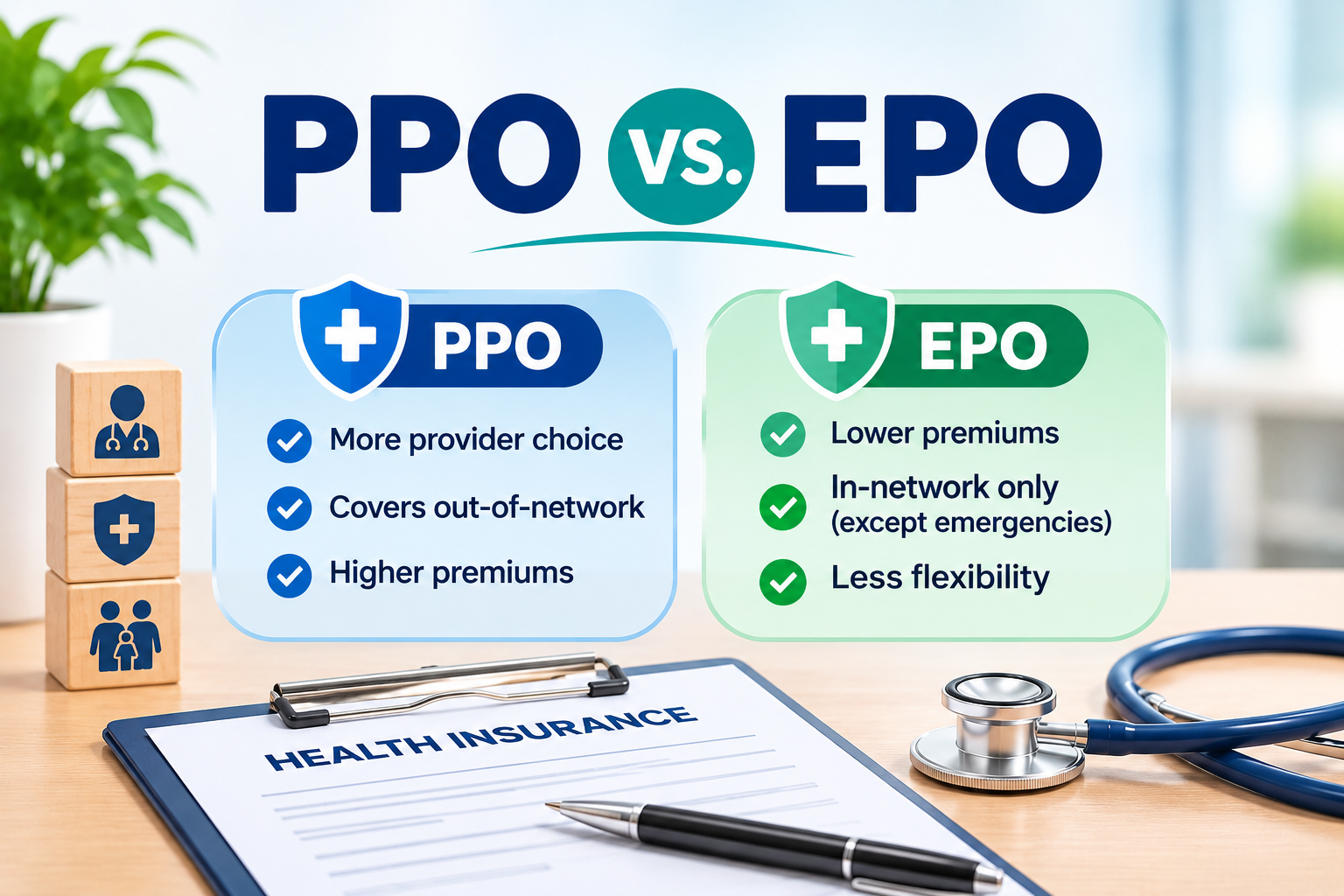
Choosing health insurance might just hinge on the type of plan, and in all honesty, how can you even start to know the difference when it is an alphabet struggle of PPO vs EPO? Ultimately, what should concern you, is which one works for your life. What the scoop is: A PPO usually covers in-network and out-of-network care, while an EPO only pays out for in-network providers except in the case of emergencies.
Both plans generally allow you to see specialists without referrals, but the main trade-off is between premiums and provider choice. You can explore the different types of health insurance plans to understand how provider networks and coverage rules vary.
Let me explain exactly what it implies for your pocket and for your visits to the doc.
PPO vs. EPO: The Core Difference
| Feature | PPO | EPO |
| Full Name | Preferred Provider Organization | Exclusive Provider Organization |
| In-Network Coverage | Yes | Yes |
| Out-of-Network Coverage | Generally covered | Generally not covered (except emergencies) |
| Specialist Referral | Usually not required | Usually not required |
| Provider Flexibility | Higher | Lower |
| Typical Premiums | Often higher | Often lower |
| Network Size | Larger | Smaller/More restrictive |
| Best For | People wanting flexibility | People comfortable with network limits |
Important: Plan benefits vary by insurer. Always check your specific plan’s Summary of Benefits and Coverage and provider directory; this comparison shows general patterns, not guarantees.
What Is a PPO? The Flexibility Plan
A Preferred Provider Organization is basically what it sounds like: insurance that prefers certain providers but doesn’t require you to use them. You can also explore what PPO means in health insurance to understand its provider network and coverage structure in more detail.
How it actually works: You pick your doctors from a preferred network (which is usually huge), and you pay less when you use them. Want to see someone outside that network? You can—you’ll just pay more out of pocket. No referrals needed for specialists. No permission slips. Just you and your insurance company picking up a bigger share of the bill when you go off-road.
The cost structure: PPOs have lower in-network costs, but higher out-of-network costs. If your specialist isn’t in the network, you’re looking at potentially paying 30-50% of the bill instead of your normal copay. That’s why comparing total potential costs (not just premiums) matters.
What Is an EPO? The Network-Focused Plan
An Exclusive Provider Organization is the insurance company drawing a clear line: stay in this network, and we cover you. Leave it, and you’re on your own (except emergencies). Learn more about how an EPO health insurance plan works and what its coverage restrictions mean for policyholders.
Here’s the real limitation: With an EPO, out-of-network care means you often pay the full bill. That’s not exaggeration—many EPOs don’t cover out-of-network services beyond true emergencies. If you need a root canal from your trusted dentist who’s outside the network, you’re writing that check yourself.
The tradeoff? Lower premiums. The insurance company saves money by limiting its network, and they pass some of those savings to you. Whether it’s actually a saving depends entirely on whether your doctors are in that network.
Cost Breakdown: It’s More Than Just the Premium
People always fixate on monthly premiums. “$150 a month? That EPO sounds great!” Then they have a specialist visit and regret everything.
Monthly Premiums: Yes, EPOs are usually cheaper. Maybe $100-200 less per year in premiums. But that’s just the beginning of the equation.
Deductibles: This is where it gets real. You might have a $1,500 deductible on either plan. Until you hit that number, you’re paying full price (or a percentage) for doctor visits, tests, whatever. A PPO and EPO can both have high deductibles. Understanding what a deductible in health insurance means can help you compare the actual costs of different plans.
The real math: An EPO with a lower premium but a $2,000 deductible isn’t automatically cheaper than a PPO with a higher premium and a $500 deductible—especially if you need specialist care outside the network.
Out-of-Pocket Maximum: This is the number that actually matters for your financial safety. It’s the most you’ll spend in a year on healthcare costs. Once you hit it, insurance covers 100%. Make sure you compare this across plans, not just the monthly cost.
PPO Vs EPO Pros and Cons
PPO Pros and Cons
| Pros | Cons |
| You keep your current doctors (if they’re in-network or don’t matter as much) | Premiums are higher—sometimes significantly |
| You’re not locked into a network if your situation changes | Out-of-network care gets expensive fast |
| Traveling? You’re more likely to find providers | More complex cost-sharing to track |
| Specialists without referrals | Requires more diligence when choosing providers |
| Peace of mind if your health needs are unpredictable |
EPO Pros and Cons
| Pros | Cons |
| Lower premiums (usually) | Your preferred doctor isn’t covered |
| Predictable in-network costs | That specialist you need is out-of-network |
| Simpler structure to understand | Limited options in rural areas |
| Works great if your doctors are already in-network | Travel frequently? Limited coverage outside network |
| No referrals for specialists | Leaving the network could mean paying full price |
Which One Should You Actually Choose?
Neither is universally “better.” I mean that. The better plan is the one that covers the healthcare you actually need, at a cost you can actually afford.
Choose a PPO if:
- You have specialists you want to keep seeing
- Your doctor isn’t in many networks
- You travel frequently
- You’re willing to pay more for flexibility
- Your healthcare needs are unpredictable
Choose an EPO if:
- Your preferred doctors are definitely in-network
- You rarely need out-of-network care
- Lower premiums are your priority
- You live in an area with solid network coverage
- You’re willing to check the network before each visit
Real-World Scenarios
Scenario 1: Your dermatologist isn’t in the EPO network You get a referral for a skin specialist. The EPO doesn’t cover out-of-network specialists. That’s $1,000+ out of your pocket. A PPO covers it at a higher rate, maybe costing you a few hundred instead.
Scenario 2: You travel for work twice a month An EPO’s network might not follow you to different cities. A PPO gives you more flexibility to see providers wherever you are. That’s worth something when you’re managing healthcare across multiple states.
Scenario 3: Your primary care doctor is in-network for both But you have three specialists. Two are in the EPO network, one isn’t. The EPO saves you money unless that third specialist matters—then the PPO’s flexibility becomes valuable.
How to Actually Decide
Before open enrollment ends, check these:
- Is your current doctor in-network? Don’t assume. Call their office or check the insurer’s provider directory.
- What about your specialists? List them out. Check each one.
- Your preferred hospital—is it in-network? Don’t skip this step.
- Compare out-of-pocket maximums, not just premiums. This is your financial ceiling.
- What are your expected healthcare costs? Be honest. Do you see a therapist? Need regular imaging? That math changes things.
- Check prescription coverage. Does the plan cover your medications? At what tier?
- Consider telehealth. Both plans usually offer it, but coverage varies.
PPO vs. EPO vs. HMO: The Bigger Picture
If you’re also seeing HMOs in your options, here’s how they stack up. Another plan type worth understanding is a Point of Service (POS) health insurance plan, which combines certain features of HMO and PPO coverage.
| PPO | EPO | HMO | |
| Out-of-Network Coverage | Yes | No | No |
| Specialist Referral | Usually no | Usually no | Often required |
| Provider Flexibility | High | Medium | Lower |
| Typical Cost | Higher premiums | Lower | Lower |
HMOs are the most restrictive but cheapest option. EPOs sit in the middle. PPOs offer the most flexibility but cost more. There’s no free lunch—flexibility costs money.
The Bottom Line
Stop thinking about PPO vs. EPO as a choice between “expensive flexibility” and “cheap limitations.” Think about it as: What does my family actually need covered, and what’s that worth to us?
A PPO makes sense if provider choice and out-of-network coverage matter. An EPO works if your doctors are in-network and lower premiums are the priority. The “better” plan is the one that covers your life without leaving you stressed about surprise bills.
Before you enroll: list your doctors, check the network, compare deductibles and out-of-pocket maximums, and do the actual math on what you’ll spend. That’s worth more than any internet article.
FAQs
Is a PPO always better?
No. If all your doctors are in an EPO’s network and you never need out-of-network care, the PPO’s extra cost isn’t worth it. You’re paying for flexibility you don’t need.
Is EPO coverage really that limited?
Yes. Many EPOs don’t cover non-emergency out-of-network care at all. You pay 100%. That’s not an exaggeration—check your plan documents.
Do I need referrals with either plan?
Generally no—both PPOs and EPOs usually let you see specialists directly. But individual plans vary. Always verify.
Which is better for families?
Whichever covers your kid’s pediatrician, your family doctor, and your specialists. A family plan is only good if it actually covers your family’s needs.
Can I change later if I pick wrong?
Only during open enrollment or if you have a qualifying life event (marriage, new job, birth). You’re typically locked in for a year, so choose carefully.
Disclaimer:
This article is intended for general informational purposes only and should not be considered insurance, medical, or financial advice. PPO and EPO plan benefits, provider networks, coverage limits, premiums, deductibles, and out-of-pocket costs vary by insurer and specific policy. Always review the plan’s Summary of Benefits and Coverage, provider directory, and policy documents, and confirm coverage details directly with your insurer before enrolling or making healthcare decisions.